When an Unnatural Move Does the Trick
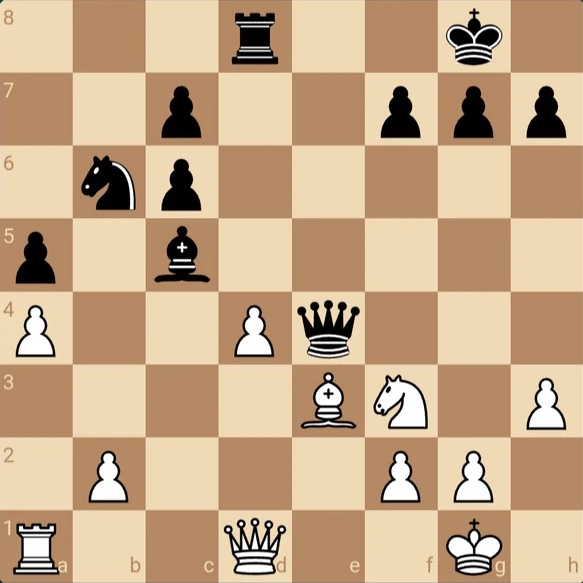
White is to play in a position where the central tension immediately catches the eye. At first glance, Black's bishop on c5 is attacked by the d4 pawn, yet White cannot simply capture it with 1.dxc5 because the pawn is pinned along the d-file by Black's rook on d8 against the White queen on d1.
Tempting Alternatives and the Simple Solution
Even after noticing the pin along the d-file, some players still went for 1.dxc5 Rxd1+ 2.Rxd1, giving up the White queen for a Black rook and bishop in the hope of emerging with a favorable position. However, after 2...Nd5, Black consolidates and stands better.
In my own attempt, I looked for something like 1.Qb3. The idea was to move the queen to a square where she felt more developed and useful than on d1, break the pin on the d4 pawn, and perhaps follow up with a move like 2.Ng5 later on if the position allowed me to build an attack against the Black king.
The actual solution to the puzzle is very simple though: 1.Nd2. By stepping back to d2, the knight interposes between the White queen and Black's rook on d8, unpinning the d4 pawn and renewing the threat of 2.dxc5. At the same time, from d2 the knight directly attacks the Black queen on e4. Black has no way to save both pieces.
Why We Miss 1.Nd2
Stepping back to ask why such a straightforward one-move attack and unpin went unnoticed brings up a few possible explanations:
-
•
Overestimating the Pin on d4: Focusing too much on the problem of the pinned d4 pawn can put us into a passive mindset where we only think about sidestepping the pin with the queen rather than interrupting the line of fire more actively.
-
•
Looking for a Ghost Attack: It is easy to get distracted by vague attacking ideas against the opposing king, such as pairing a queen move with a later knight jump to g5, even when there is no real kingside attack in the position.
-
•
Relying on Opening Guidelines Instead of Concrete Tactics: This feels like the main culprit. Because several White pieces are still sitting on squares they usually occupy in the opening, with the queen on d1, the rook on a1, and the knight on f3 developed just once without advancing further, it is tempting to look only for moves that feel natural and follow standard opening principles. The best move, 1.Nd2, works for concrete tactical reasons, but it does not feel natural at all. Instead of moving the knight forward, it retreats to the second rank and seems to get in the way of White's own queen and bishop.
Sometimes a position simply calls for an unnatural-looking move that gets the job done.