Walkthrough
Welcome to ChessKinetics. This chess trainer was built to help improve chess vision without the fatigue that often comes with continuous puzzle solving. Traditional trainers continuously adapt to your rating, constantly pushing you at the very edge of your abilities. ChessKinetics takes a different approach. It uses a wave progression system to manage cognitive load. The application blends challenging puzzles with active recovery periods. This structure supports consistent learning and keeps the training process manageable.
Setting Your Rating
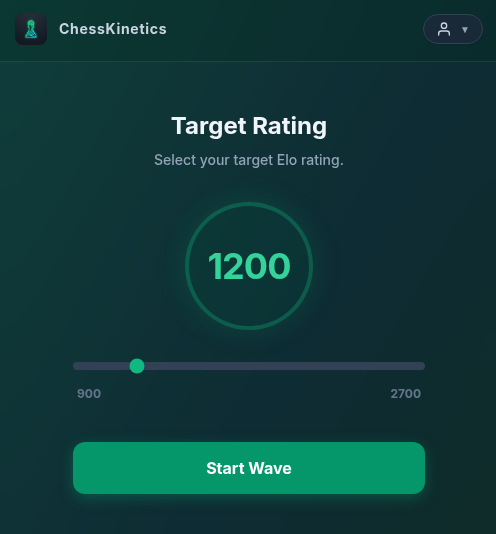
The first step when starting with ChessKinetics is to set an initial rating. This step allows the algorithm to calibrate the difficulty of the training immediately. Instead of beginning with puzzles that are either too trivial or overwhelmingly difficult, providing a rating ensures the system places the user in the appropriate starting bracket for their very first wave.
The Warm-up Puzzle
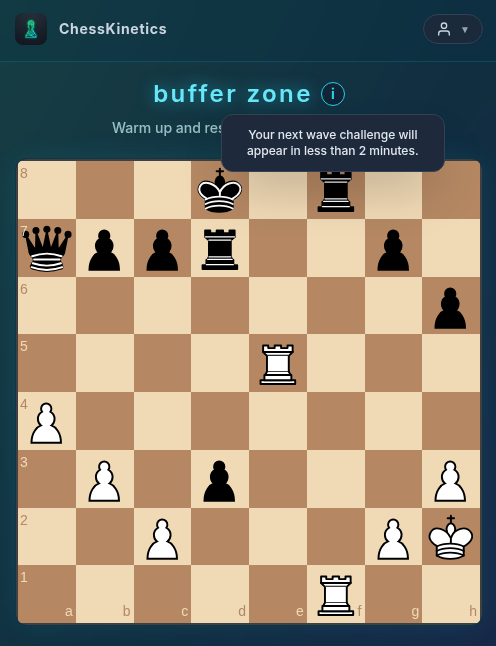
Once the rating is submitted, the session begins with an active recovery phase. This acts as a warm-up. The system presents a single, easy puzzle to help you ease into the board and get comfortable with the interface before the main training wave starts.
Riding the Wave
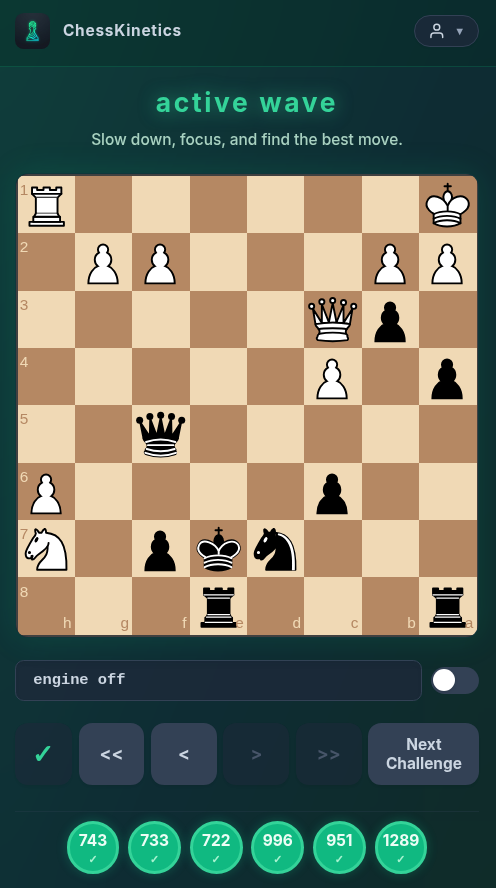
After the warm-up puzzle, the main training wave begins. Each wave consists of a structured sequence of up to six puzzles divided into three distinct phases. Phase 1 starts with three foundational puzzles to build momentum. Phase 2 introduces two moderately harder puzzles, and Phase 3 concludes the wave with a single, highly challenging puzzle that tests your limits. This gradual increase ensures that the difficulty scales naturally without overwhelming you right away.
Distraction-Free Analysis
After completing a wave puzzle, an analysis mode appears automatically in place. The interface remains simple, avoiding the overwhelm of complex variation trees. You can navigate through moves using basic position-transition buttons and explore alternatives directly on the board. The built-in Stockfish 18 engine is turned off by default, but when enabled, it provides a single, clear evaluation line. This gives enough insight to understand the position and learn from the puzzle without cluttering the screen before you move on to the next challenge.
The Active Recovery Buffer
ChessKinetics uses active recovery periods to manage cognitive fatigue. If a mistake is made during Phase 1 or Phase 2, or upon completing a full wave, a two-minute recovery buffer is triggered. During this time, the application serves a continuous flow of very easy, low-stress puzzles. This buffer provides an opportunity to clear the mind and regain confidence. Additionally, if two mistakes occur in a single wave, the wave is automatically aborted to prevent frustration, and a new recovery phase starts immediately to reset the session.
Continuous Progression
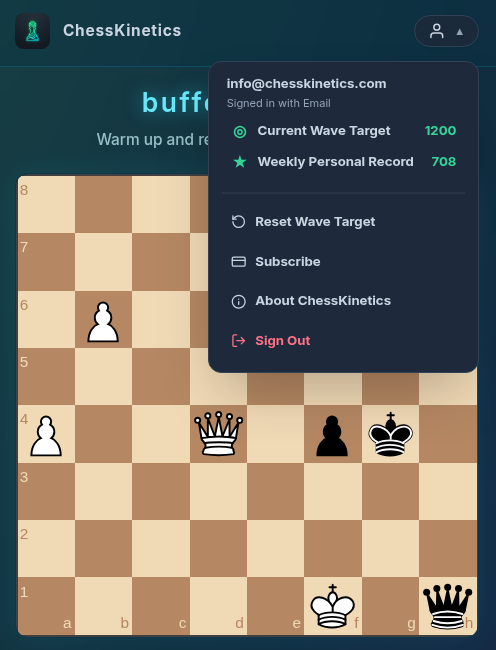
Once a wave is completed, the difficulty of the next wave adapts directly to the performance in the previous one. A flawless wave increases the upcoming challenge, a wave with a single mistake maintains the current level, and a wave with two mistakes lowers the difficulty to help rebuild momentum. This dynamic progression is visible in the user menu, which tracks two key metrics: the Current Wave Target, showing the target rating for the active session, and the Weekly Personal Record, tracking the highest rating achieved during the last seven days.
Training Limits and Subscriptions
ChessKinetics is accessible for free, allowing up to two training waves per 24 hours. This provides enough volume for a consistent daily practice. For those who wish to train more intensively, a subscription unlocks unlimited access to the algorithm. Upgrading removes the daily limit, allowing for uninterrupted training sessions regardless of volume.
Getting Started
The goal of ChessKinetics is to make tactical training sustainable. By managing cognitive limits and providing a structured progression, the application helps build better chess vision over time without the usual frustration. Sign in to set an initial rating and begin your first training wave.