Chasing Lost Rating Points: Tilt in Games and Puzzles
Published on October 13, 2026
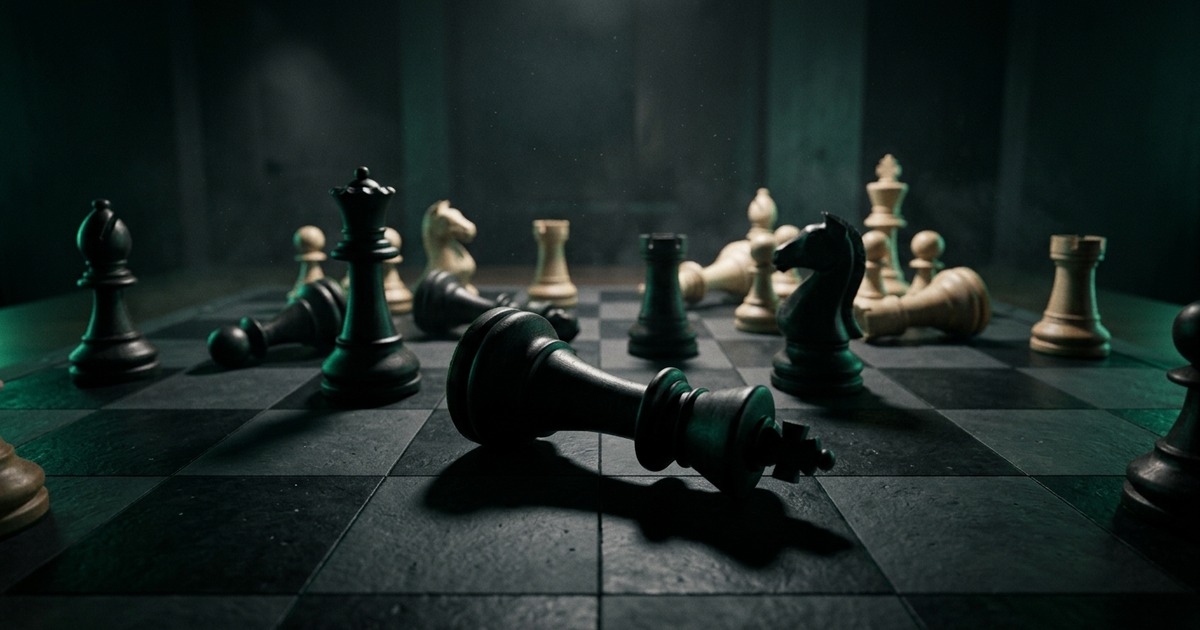
Most chess players know this feeling. You lose a game you expected to win and your rating drops a few points. Right away you click for a new game, telling yourself you will win the points back in the next ten minutes. Then you lose that one too. The gap gets bigger, and the next game starts even faster.
The Loop
When I look closely at this situation in my own games, it tends to follow the same order:
-
1.
A game is lost.
-
2.
The main goal becomes getting the rating back.
-
3.
Patience goes down.
-
4.
The quality of play drops, and another game is lost.
Each step feeds the next one. Somewhere along the way the goal changes without us noticing. We stop trying to play a good game and start trying to undo the last one. Every new loss makes the urge to recover stronger, so the loop speeds up instead of settling down.
A Familiar Name
Chess players usually call this tilt, a word borrowed from poker. Gambling research has a closely related term, loss chasing: continuing to play in order to win back what was lost, usually with more risk and less care. Chess works the same way, only the currency is rating points instead of money.
What Changes at the Board
Impatience shows up in a few concrete ways:
- Moves are played faster than usual, even when there is time on the clock.
- The last check for opponent threats before moving gets skipped.
- Sharp, risky lines are chosen in the hope of winning quickly.
- Reasonable draws are turned down because a draw does not "fix" anything.
- Our own position looks better than it actually is.
Calculation is usually the first thing to go. Once speed matters more than accuracy, the moves that take the most thought are the ones that get neglected.
The Same Pattern in Puzzles
Puzzle training is no exception. Most puzzle trainers show your rating change after every single puzzle. After a failed puzzle it is tempting to rush into the next one, play the first forcing move that looks plausible, and hope it works. Solving turns into guessing.
Puzzles only take seconds, so the loop can repeat many times in just a few minutes. Losing a large number of rating points in one short session is not unusual. What the number does not show is the real cause. The puzzles did not suddenly get harder. The person solving them got tired and impatient.
Why Willpower Is Not Enough
This is hard to notice from the inside. The state that causes the problem also clouds the judgement you would need to spot it. In the middle of a losing streak, "one more game" always sounds reasonable.
That is why many players set rules in advance, such as stopping after two losses in a row. These rules work because they are made while calm, before emotions get involved.
Breaks as a Checkpoint
A mandatory break interrupts the loop. Rest is part of its value, but the bigger part is the moment it creates to ask a few honest questions. Is my head clear? Am I playing to improve, or to get points back? Would I start a serious game right now if my rating had not just dropped?
Breaks that are optional rarely get taken when they are most needed. Making them part of the routine removes that decision from the moment when we are least able to make it well.
A break also only helps if it is actually used as one. Staring at the screen and replaying the lost game in your head does not give the mind much of a rest.
How This Shaped ChessKinetics
These observations played a big part in how I designed the training flow in ChessKinetics. Training in the app is organized in waves. A wave is a short set of up to six puzzles that gradually gets harder: three easier puzzles to start, then two closer to your target rating, and finally one slightly above it.
The Buffer Zone is a mandatory break of at least two minutes. It follows every completed wave, and it also starts whenever one of the first five puzzles is solved incorrectly, pausing the training until the break is over.
During the Buffer Zone, the app serves easy puzzles that do not affect your wave progression. Solving them is optional. The main purpose of the break is to give you a moment to check your state honestly before the next serious attempt:
-
•
If you feel full of energy but a bit rusty, you can stay and solve the easy puzzles to get back into a rhythm.
-
•
If you feel tired, you can step away from the screen, even for longer than two minutes.
-
•
If you are not sure how you feel, the recommended option is to step away and not look at the screen until your head clears.
The last point matters most when it comes to tilt. Not being sure about your own mental state is a warning sign in itself. It is also exactly the moment, right after a mistake, when most of us would rather jump straight back in.
A few other details work toward the same goal:
- If two mistakes happen in the same wave, the wave is aborted and a new Buffer Zone begins.
- The rating of a wave puzzle is hidden while you solve it and only shown afterwards, so your attention stays on the position instead of the number.
- The target rating only changes after a full wave, not after each puzzle, so there is no number moving with every attempt to chase.
- The Weekly Personal Record shows the rating of the hardest puzzle you solved in the last seven days. A failed puzzle does not take anything away from it, so there is nothing to "win back".
I do not claim this removes tilt entirely. No software can fully control how we react to losing. But a clear structure makes it harder for the loop to build momentum.
A Few Practical Suggestions
Whatever tools you use, a few habits can help:
- Decide when the session will end before you start it.
- After a loss, take a short pause before the next game. Stand up, get some water, and ask yourself whether you are ready. If you are not sure, treat that as a no.
- Learn your own early signs, such as playing faster than usual, skipping checks, or feeling irritated with the opponent.
- Judge progress over weeks rather than single sessions. Ratings move up and down, and a bad evening says very little about your real strength.
Rating points lost in one session can always be won back later. What is harder to get back is the time spent playing in a state where you are not really learning anything.